# Old Code & Large Numbers
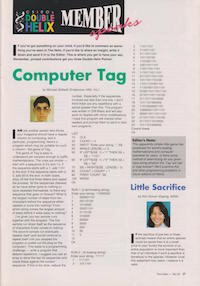
Found an old passive aggressive (or maybe just aggressive) letter of mine that
was published in an Australian science magazine for teens called _Double Helix_.
Horrible photo. It includes code, in BASIC. Numbered lines. There is a "clear screen" command though I seem to have avoided `GOTO`.
 Not really related, but while looking through Wikipedia for more information on
this problem (it's an an example of a [Tag
System](https://en.wikipedia.org/wiki/Tag_system)), I came across some
[fascinating examples of conjectures that have extremely large (numeric)
counter-examples](https://en.wikipedia.org/wiki/Collatz_conjecture#Experimental_evidence).
(i.e. conjectures resistant to computer-derived counter-examples, and common
sense.)
They are:
- [Pólya conjecture](https://en.wikipedia.org/wiki/P%C3%B3lya_conjecture) - initial counterexample was 1.845 × 10361, though now reduced to 906,150,257.
- [Mertens conjecture](https://en.wikipedia.org/wiki/Mertens_conjecture) - upper bound is _e_1.59×1040.
- [Skewes' number](https://en.wikipedia.org/wiki/Skewes%27_number) - somewhere around _e_727.95133.
Scott Aaronson has an intriguing blog post on [the biggest number you can write down in 15 seconds using standard math notation](http://www.scottaaronson.com/writings/bignumbers.html).
See also [Graham's number](https://en.wikipedia.org/wiki/Graham%27s_number).
